
Any Town Tree in Naples, FL, Explains How Common Watering Habits Are Quietly Harming the Trees on Your Property
What You Don’t Know About Irrigation Could Be Costing You Trees
In Naples and throughout Southwest Florida, most homeowners with a landscape irrigation system assume their trees are covered. The system runs, the yard gets wet, and the trees look green – so everything must be fine.
The reality is more complicated than that. Irrigation systems in this region are almost universally designed and programmed around lawn and shrub needs, not tree needs. And the gap between what a turf-optimized irrigation schedule delivers and what trees actually require is where a surprising amount of tree health damage quietly originates.
Some of the most common and most damaging irrigation mistakes we see aren’t dramatic failures – they’re well-intentioned habits that slowly undermine tree health over months and years. Here’s what to look out for, and what good irrigation practice actually looks like for trees in Southwest Florida.
Mistake #1: Running Lawn Irrigation Schedules for Trees
This is the most widespread irrigation mistake in Southwest Florida landscapes, and it plays out on nearly every property with an automated system. Lawn sprinkler systems are programmed for turf – frequent, shallow cycles that keep the top few inches of soil consistently moist. That schedule is appropriate for grass. It is almost never appropriate for trees.
Trees need water delivered deeply and infrequently. Deep watering encourages roots to grow downward and outward, developing the robust root architecture that supports stability and long-term tree health. Shallow, frequent watering does the opposite – it keeps roots concentrated near the surface, chasing the moisture that’s always sitting at the top of the soil profile. Surface-rooted trees are more vulnerable to drought stress when irrigation is interrupted, less stable in high winds, and more susceptible to the kinds of soil-borne pathogens that thrive in consistently moist, shallow soil.
The practical fix isn’t necessarily adding a separate irrigation system for every tree – it’s understanding that mature, established trees in Southwest Florida generally need much less supplemental irrigation than people think, delivered much less often. A slow, deep soak reaching the full depth of the root zone is far more valuable than daily shallow sprinkler coverage.
Mistake #2: Never Adjusting for Rainy Season
Southwest Florida has one of the most pronounced wet-dry seasonal cycles in the country. Naples averages around 55 inches of rain annually, with the majority falling between June and September – often in daily afternoon storms that can deliver significant rainfall in a short period. Running an automated irrigation system on its dry-season schedule through the heart of rainy season is one of the fastest ways to chronically overwater trees.
Chronically overwatered trees in Southwest Florida’s sandy soils develop a specific and serious problem: Phytophthora, a soil-borne pathogen present throughout Florida’s soils that thrives in excessive moisture. When soil stays wet for too long – whether from overextended irrigation or accumulated rainfall with no irrigation adjustment – Phytophthora can move into a tree’s vascular system and cause rapid, severe decline. Symptoms include browning leaves, bleeding from the trunk, and overall collapse that can progress faster than most homeowners expect. By the time it’s visible, the tree has usually been under significant pathogen pressure for some time.
A smart irrigation approach in Southwest Florida means programming rain sensors that actually shut the system down when rainfall is adequate, manually adjusting schedules seasonally, and checking soil moisture before running supplemental irrigation – not running the system on a fixed calendar schedule regardless of what the sky has been doing.
Mistake #3: Sprinkler Heads Too Close to the Trunk
Where irrigation water is delivered matters just as much as how much is delivered. A common setup issue on residential properties in Naples is sprinkler heads positioned too close to tree trunks – either because the system was installed before the tree grew to its current size, or because the system was never properly calibrated for the landscape as it evolved.
Chronically wetting the base of a tree trunk creates ideal conditions for fungal decay and disease. The trunk flare – the area where the trunk meets the root system at ground level – needs to stay relatively dry to remain healthy. Continuous moisture against bark tissue softens it, invites fungal colonization, and over time can cause the kind of basal decay that compromises a tree’s structural integrity from the ground up. This type of damage is often invisible until it’s severe – and a tree that looks perfectly healthy from the outside can have significant internal decay at its base as a result of years of poor irrigation placement.
The fix is straightforward: irrigation coverage should be directed toward the root zone – roughly the area under the canopy drip line and beyond – not toward the trunk itself. If your system regularly soaks the trunk of your trees, that’s worth correcting.
Mistake #4: Overhead Sprinklers Hitting the Canopy
Irrigation that sprays directly onto tree foliage creates two distinct problems that many homeowners never connect back to their watering schedule.
The first is fungal disease. Southwest Florida’s heat and humidity already create conditions where fungal pathogens flourish. Adding regular moisture to leaf surfaces – particularly in the evening when temperatures drop and foliage stays wet overnight – significantly increases the risk of foliar fungal diseases. Leaves that are repeatedly wet and then dry unevenly, or that stay wet through the night, are far more susceptible to the kinds of infections that cause leaf spots, canopy dieback, and chronic tree health decline.
The second problem is less obvious but equally real: wet foliage in direct Florida sun can cause leaf scorch. Water droplets act as a lens that concentrates sunlight, burning leaf tissue in patterns that are often mistaken for disease or nutrient deficiency.
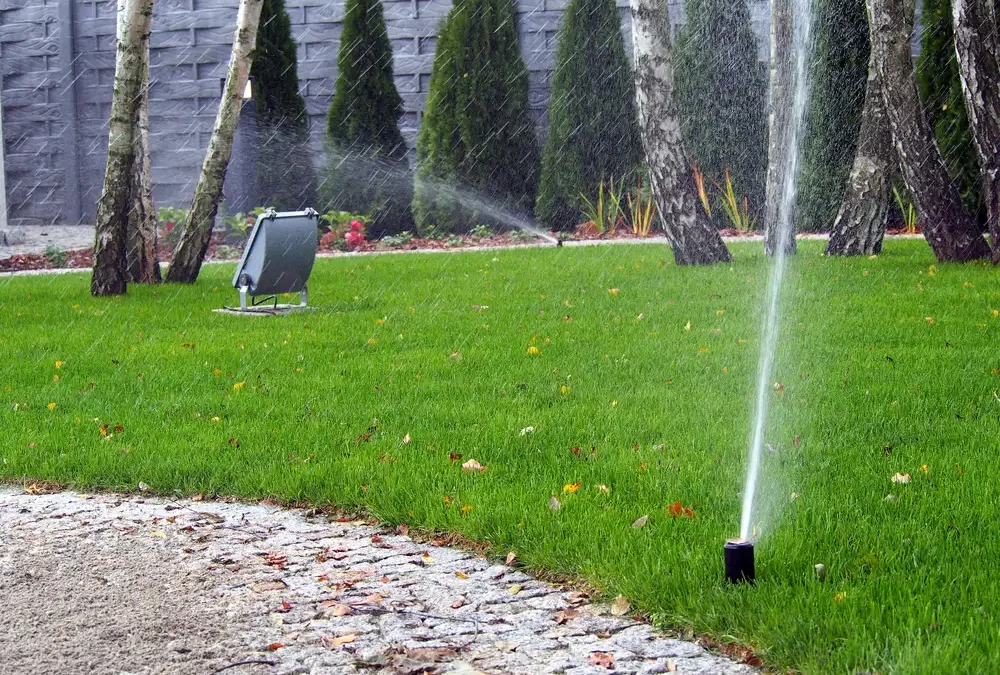
If your irrigation system sprays tree canopies as part of its normal cycle, adjusting head positioning or switching the affected zones to drip delivery makes a meaningful difference in long-term tree health. UF/IFAS consistently recommends irrigation that wets the root zone without wetting foliage – and scheduling any overhead irrigation that does contact leaves to run in the early morning so foliage can dry before peak sun and heat arrive.
Mistake #5: Ignoring Newly Planted Trees
The irrigation needs of a newly planted tree are fundamentally different from those of an established one – and getting this wrong in either direction causes serious problems.
New trees haven’t yet developed the root system needed to draw water efficiently from the surrounding soil. In the critical establishment period – typically the first one to three years after planting – supplemental irrigation focused directly on the root ball is essential, particularly during Naples’s dry season between November and May. Relying on lawn irrigation coverage to handle newly planted trees often leaves them underwatered at the root level even when the surrounding soil appears moist.
At the same time, overwatering newly planted trees is a genuine and common mistake. The instinct to give a new tree extra water out of care can quickly lead to root suffocation in poorly draining soil – a condition where the roots are deprived of oxygen, the tree struggles to establish, and Phytophthora and other pathogens find an easy target.
The right approach is targeted, moderate watering directly at the root ball, monitored carefully and adjusted based on actual soil moisture rather than a fixed schedule. As the tree establishes and its root system expands, irrigation needs to be scaled back and redirected accordingly.
Mistake #6: No Mulch to Support the Irrigation You Are Doing
This one isn’t technically an irrigation mistake – but it undermines whatever irrigation practice you do have. In Southwest Florida’s sandy soils, water drains quickly. Moisture that takes minutes to apply can disappear from the upper root zone within hours on a hot Naples afternoon. Without a proper mulch layer, irrigation water evaporates from the soil surface before it can move into the deeper root zone where established trees actually need it.
A 3–4 inch layer of organic mulch under a tree’s canopy – kept 4–6 inches away from the trunk itself – dramatically improves soil moisture retention, moderates soil temperature, and supports the biological activity that healthy roots depend on. In practical terms, it means the irrigation water you do apply works harder and lasts longer, and established trees need supplemental watering less frequently during dry periods.
Mulch also buffers the root zone from the compaction that occurs when soil dries and rewets repeatedly – a particularly important consideration for properties where irrigation cycles are creating that pattern around tree roots.
What the Symptoms Actually Tell You
One of the most frustrating aspects of irrigation-related tree health problems is that overwatering and underwatering produce nearly identical visible symptoms: yellowing leaves, wilting, thinning canopy, premature leaf drop, and poor new growth. The instinct when a tree looks stressed is to water more. If the real problem is overwatering – or a Phytophthora infection triggered by excess moisture – more water accelerates the decline rather than reversing it.
This is precisely where a professional plant health care assessment pays for itself. An arborist who evaluates the soil moisture, the root zone condition, the irrigation setup, and the tree’s full health picture can tell the difference between a tree that’s thirsty and a tree that’s drowning – and between irrigation stress and a tree disease that requires a different approach entirely.
Treating the symptom without understanding the cause almost always makes things worse. And in Southwest Florida’s growing conditions, where problems compound quickly in the heat and humidity, catching and correctly diagnosing an irrigation problem early is the difference between a correction and a tree removal.
Getting Your Irrigation Right Is Part of Long-Term Tree Care
Trees on well-managed irrigation schedules – appropriately calibrated for season, species, and tree maturity, with moisture delivered deep and away from trunk tissue – are consistently healthier, more structurally stable, and more resistant to the pest and disease pressure that Southwest Florida dishes out year-round.
If you’ve been running the same irrigation program since your system was installed, haven’t adjusted for rainy season in recent memory, or have trees that are declining without an obvious explanation, irrigation is one of the first things worth examining. A professional tree care evaluation that includes a look at how your irrigation is actually affecting your trees can surface problems that aren’t obvious from the outside – and give you a clear, actionable path forward.
About Any Town Tree
Any Town Tree is a Naples, FL-based tree service company serving homeowners and properties throughout Southwest Florida. From tree pruning and tree trimming to tree removal, tree risk assessment, tree disease identification, and comprehensive plant health care, our team brings genuine arborist expertise to every job.
We understand the specific demands of Southwest Florida’s climate – including the ways that irrigation habits, sandy soils, rainy seasons, and humidity combine to create tree health challenges that homeowners often don’t see coming. If your trees aren’t thriving the way they should be, we’d love to take a look.